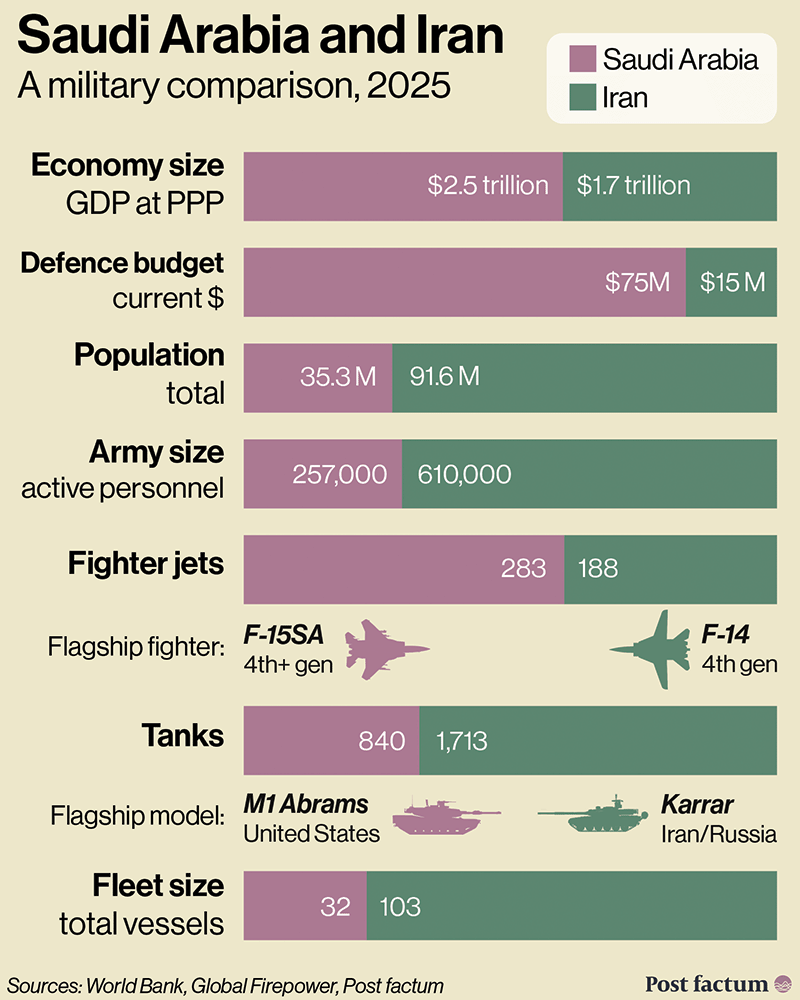
Iran is the main geopolitical rival of Saudi Arabia.
The two engage in proxy conflicts by supporting opposing groups across the Middle East.
A proxy war is a conflict where at least one of the countries is using a third country or a non-state actor to indirectly attack its opponent.
Iran-backed groups:
- Hezbollah in Lebanon
- Hamas in Gaza
- Shia militias in Iraq and Syria
- Houthis in Yemen
Saudi-backed groups:
- Sunni factions in Lebanon
- Sunni militants in Iraq and Syria
- Government forces in Yemen
Crisis point: in September 2019, drone strikes on Saudi oil facilities resulted in a 50% cut in Saudi oil production.
The Houthis claimed responsibility but evidence pointed to Iran’s involvement.
In 2023, with Chinese support, Saudi Arabia and Iran agreed to restore diplomatic relations.
In May 2025, Iran approached Saudi Arabia and the United Arab Emirates with a proposal to cooperate on uranium enrichment.
Iran’s goal is to relax international concerns about its nuclear program, including by involving neighbouring states as stakeholders or observers.
One month later, the US bombed 3 key nuclear research sites in Iran. The extent of damage is unclear.
MBS has previously said that if Iran develops a nuclear weapon, Saudi Arabia “would have to get one, for security reasons”.
Saudi Arabia has good relations with the other monarchies of the Persian Gulf: Bahrain, Qatar, Kuwait, Oman and the United Arab Emirates (UAE).
In 2015, Saudi Arabia launched a coalition intervention against the Houthis.
Goal: restore the Yemeni government and prevent a pro-Iranian state on Saudi Arabia’s border.
The intervention is ongoing but failed to defeat the Houthis who currently control Yemen’s capital.
In recent years, ceasefire talks intensified, and Saudi Arabia appears willing to stop its involvement.
Russia
Since 2016, Saudi Arabia and Russia have coordinated oil policy through OPEC+.
This cooperation continued after Russia invaded Ukraine in 2022.
Western sanctions on Russia pushed it to look for new export destinations, and Saudi Arabia emerged as one of the main partners.
In 2022, Russian agricultural exports to Saudi Arabia increased by 49% compared to the year before.
Overall trade increased 73%, from $2.2 billion in 2021 to $3.8 billion in 2024.
By June 2025, Saudi Arabia had become the largest importer of Russian fuel oil.
Why? By importing Russian fuel (processed) oil, Saudi Arabia reduces the need to refine its own crude (raw) oil.
- Saves more crude oil for export at higher prices
- Avoids paying for processing at home
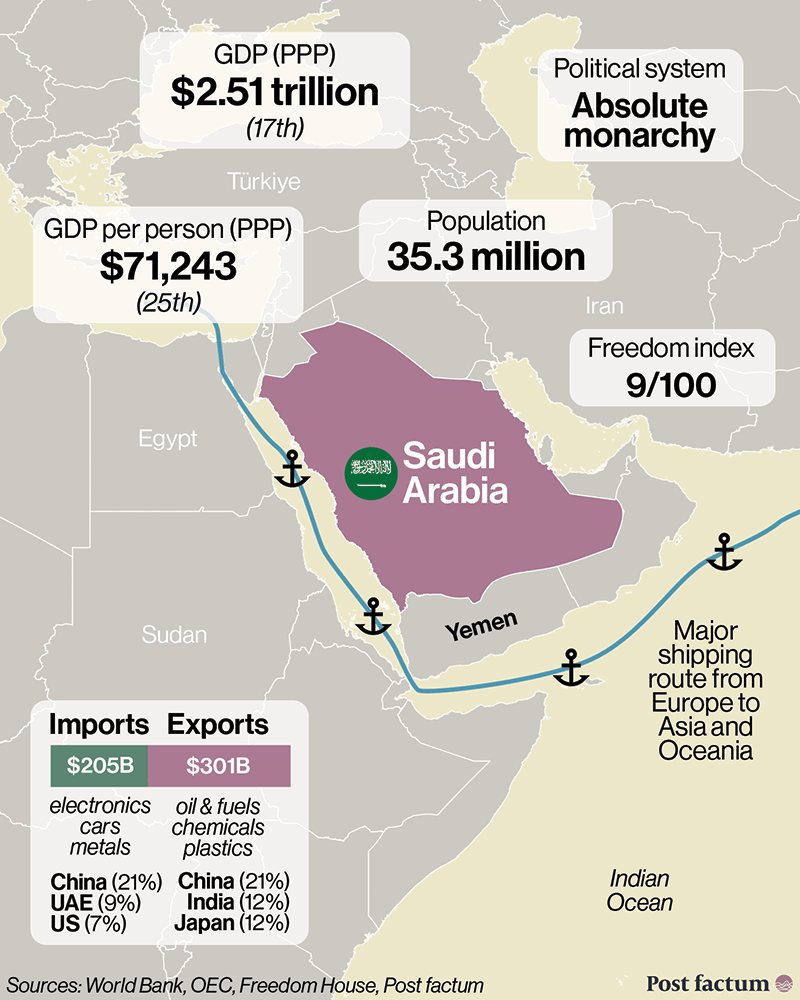
China is Saudi Arabia’s largest trading partner and the largest buyer of Saudi oil.
- China invested in several Saudi infrastructure projects, including the Mecca-Medina-Jeddah railway connecting the holy sites of Islam.
Crown Prince Mohammed bin Salman (MBS) is the most powerful figure in Saudi politics.
MBS is the son of King Salman and was appointed Crown Prince in 2017.
In 2022,MBS was appointedPrime Minister by his father.
- Traditionally, the title of Prime Minister belonged to the monarch himself. By appointing his son, King Salman transferred large executive powers to MBS. This also supports a strong succession (passing of the throne).
MBS presented an ambitious reform plan named Vision 2030.
Goal: to transform Saudi Arabia into a modernstate with a diversified economy.
Major points include:
- Reducing dependence on oil
- Expanding women’s rights
- Weakening religious fundamentalists
So far, Saudi Arabia is successfully cutting oil dependence as non-oil activitiesmade up50% of the country’s economy in 2023.
Saudi Arabia plans to generate 50% of its electricity from renewable sources by 2030.
MBS is also attempting to rebrand the country as a global luxury destination, promoting tourism and entertainment.
He aimed to draw 100 million visitors annually by 2030. This goal was achieved in 2023 and 2024.
Saudi Arabia is building NEOM, a $500 billion futuristic mega-city on the Red Sea, but the project is facing delays.