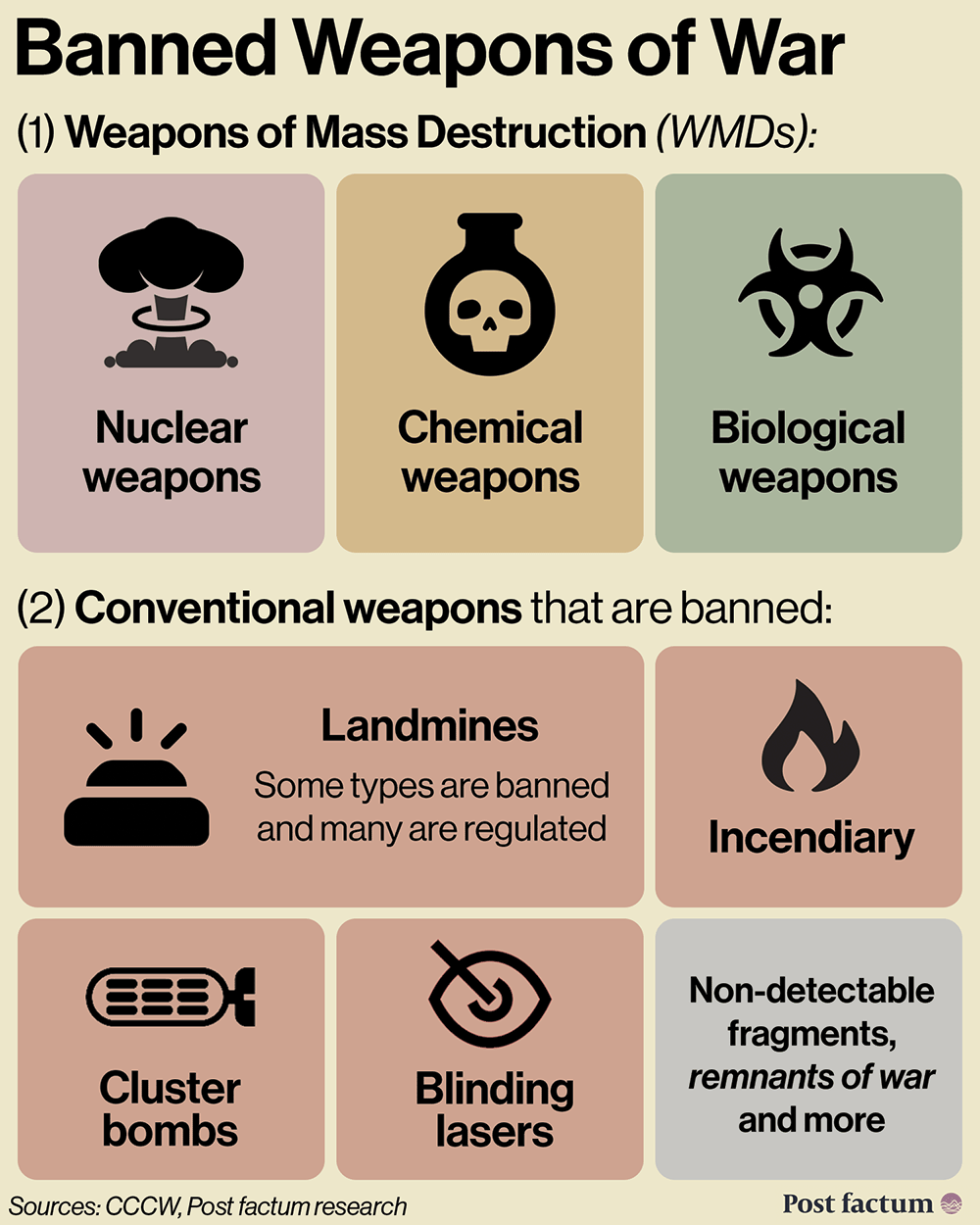
Chemical weapons
Did not join the ban: Egypt, Israel, North Korea, South Sudan.
Chemical weapons are toxic substances that kill or harm people.
These are considered especially cruelbecause of the long-term suffering they cause.
A chemical agent can be delivered with a bomb, a grenade or even an artillery shell.
- Choking agents: targets breathing, attacking lungs and airways.
- Blistering agents: causes burns and scarring on skin and eyes.
- Nerve agents: attacks the nervous system, causing body failure.
Chemical weapons were widely used during the First World War.
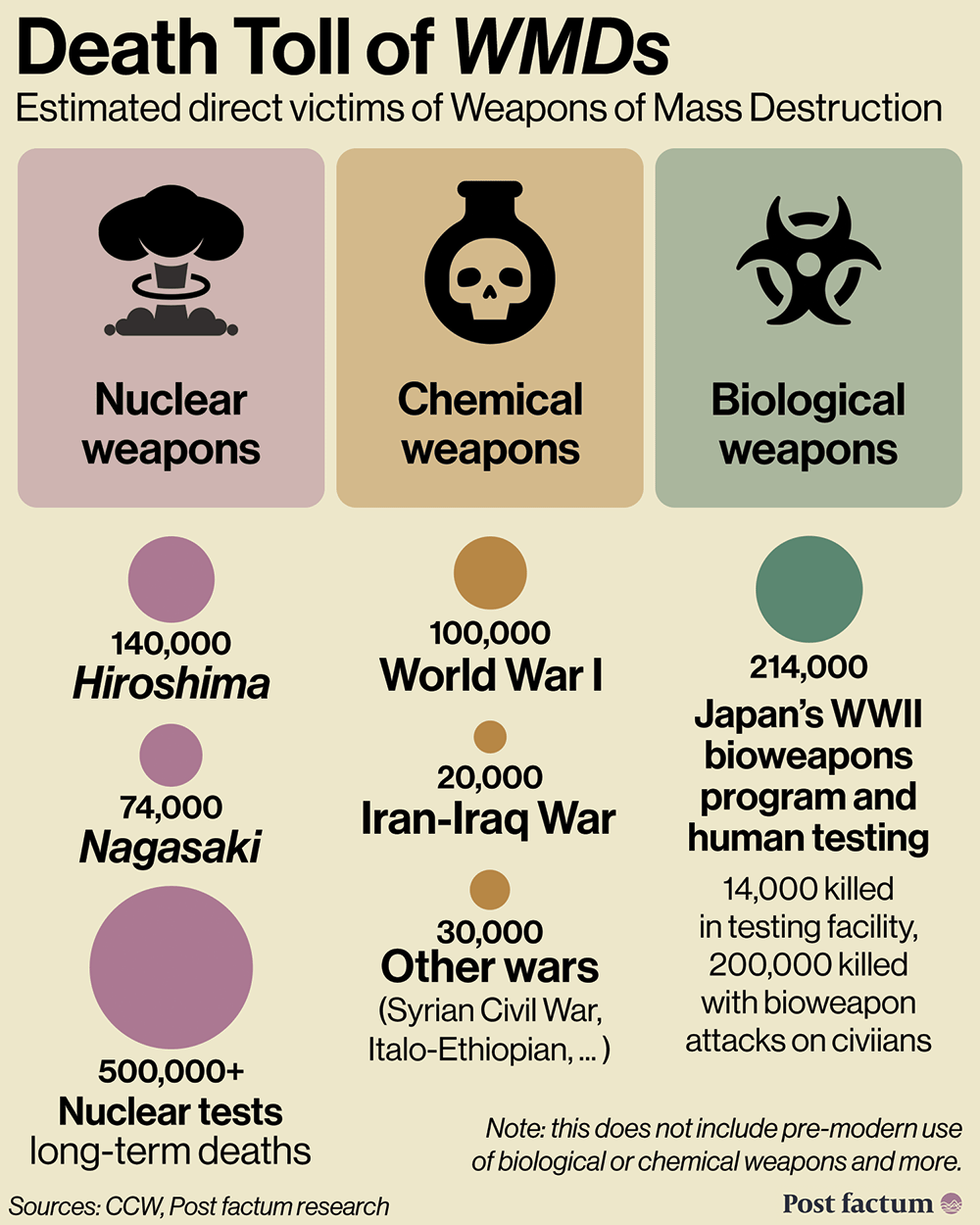
In total, around 100,000 soldiers were killed, with over a million injured.
Around 20,000 people, including civilians, were killed by Iraqi chemical attacks on Iran.
The 1925 Geneva Protocol banned the use of chemical and biological weapons.
However, the production and storage of the weapons were banned in 1997.
All officially declared stockpiles of chemical weapons have been destroyed by 2023.
However, countries continue to develop new, uncontrolled substances, that are not included on the list of chemical weapons.
- For example, Russian opposition leader, Alexey Navalny, and other figures were poisoned with a nerve agent weapon developed by Russia.
Over 300 chemical weapons attacks occurred during the civil war in Syria.
In 2013, more than 1,700 civilians were killed in a single attack by the forces of Bashar Assad.
After the attack, the international community pressured Syria to join the Chemical Weapons Convention and destroy its official stockpiles.
Biological weapons
Did not ban: Israel, Egypt, Syria and other smaller states.
A biological weapon uses pathogens (like bacteria, viruses or fungi) to kill or harm.
Unlike conventional weapons, their destructive power lies in causing a disease, which can spread and affect both military and civilian populations.
Biological agents can trigger epidemics.
They also create psychological terror: the fear of an invisible infection can destabilise a country’s public life.
Biological weapons can be delivered with regular weapon systems or by contaminating an area, a food or water source, or packages.
- In 1346, Mongol forces catapulted plague-infected bodies over the city walls of Genoa, spreading the disease among the defenders.
The bioweapons development and research program run by Japan in the 1930s and 40s carried out experiments on mostly Chinese but also Russian, Korean and other civilians.
Victims were infected with pathogens, injured, burned and later studied to advance medical knowledge for the treatment of Japanese soldiers.
Countries including Germany, the Soviet Union, the US and the UK also pursued biological warfare programs.
Unlike the Chemical Weapons Convention, the Biological Weapons Convention has no verification mechanism: no international agency to inspect the countries.
This lack of oversight leaves space for secret programs.
In 2001, soon after the 9/11 attack on the US, a terrorist sent letters with deadly anthrax bacteria to some politicians and media in the US, killing 5 people, injuring 17 and causing thousands to undergo treatment.