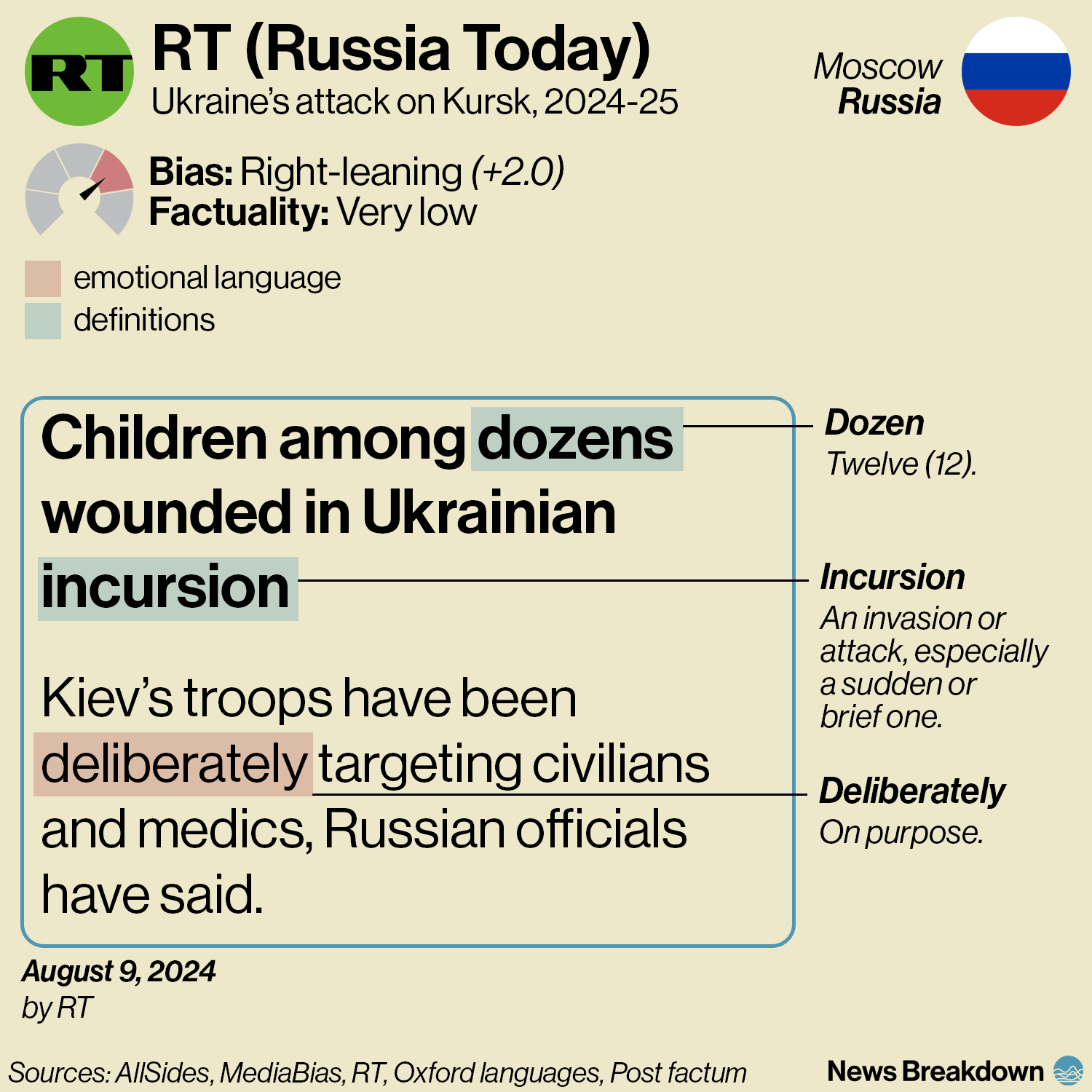
Russia Today (RT).
- State-controlled: funded and directed by the Russian government.
- International: broadcasts globally to promote Russian official narratives.
The headline by RT talks about civilian casualties, quoting a Russian official.
It also mentions that children were injured, which would trigger further anger at Ukraine’s actions from the readers.
RT then suggests that the attack was “repelled” (stopped), also quoting official statements.
Confirmations of some civilian casualties and multiple injuries did appear later.
However, there is no evidence that Ukrainian soldiers attacked or executed any civilians.
There is verified evidence of Ukraine striking civil infrastructure in Kursk. In some cases, there is also verified evidence of Russian troops entering this infrastructure before the strikes.
The text says that “Kiev’s troops launched an unsuccessful cross-border incursion”.
RT uses the spelling “Kiev” for Ukraine’s capital city, which was the commonly accepted spelling in the Soviet period. In Ukraine, this spelling is viewed negatively as it is associated with Soviet policies to discourage the use of Ukrainian language, in favour of Russian.
- Ukraine promotes the spelling “Kyiv” which is a legal requirement since 1995. Later, it pushed for international adoption of the spelling which is now widely accepted by international media.
RT reports that Ukraine lost 20 “fighters” in the attack (meaning soldiers). It does not mention any Russian losses.
RT concludes by discussing the Russian Volunteer Corps (RDK), a group of anti-Putin Russian citizens fighting for Ukraine. They launched short-term raids into Russian territories earlier in 2024.
- The article shares unverified claims that the RDK was involved in the Kursk offensive. It was later confirmed that it did not take part.
- RT calls RDK a “right-wing extremist militia force” and clarifies that it is considered a terrorist organisation in Russia. The group’s leader is a Russian neo-Nazi and a football hooligan, who owns a clothing brand popular among white supremacists and was banned from the Schengen Area in 2019.
Russian officials often claim that Ukraine’s government is controlled by a neo-Nazi regime. Connecting RDK with Ukraine’s actions in Kursk promotes this narrative.
One of the goals of the Russian invasion is stated as “to de-Nazify” Ukraine.
Ukraine’s far-right parties received 2% of votes in the last democratic election in 2019, less than some far-right parties in other European countries such as Italy where Fratelli d'Italia won 26% of votes.
However, some of the few far-right Ukrainian parliamentarians have made extreme remarks, including anti-Semitic and nationalist rhetoric.
In addition, the country has a complex political history, with many celebrated Ukrainian nationalists, such as Stepan Bandera, having a history of collaboration with the Nazi regime during its occupation of Ukraine in the 1940s.
- During this period, many anti-Soviet and nationalist groups sided with Nazi Germany.
Some Ukrainian military units including the Azov Brigade were born out of ultra-nationalist volunteer groups.
In turn, Russia also has a long history of managing neo-Nazi groups in the country.
- For example, the neo-Nazi Rusich Group is a military unit fighting against Ukraine since 2014.