Tensions with India
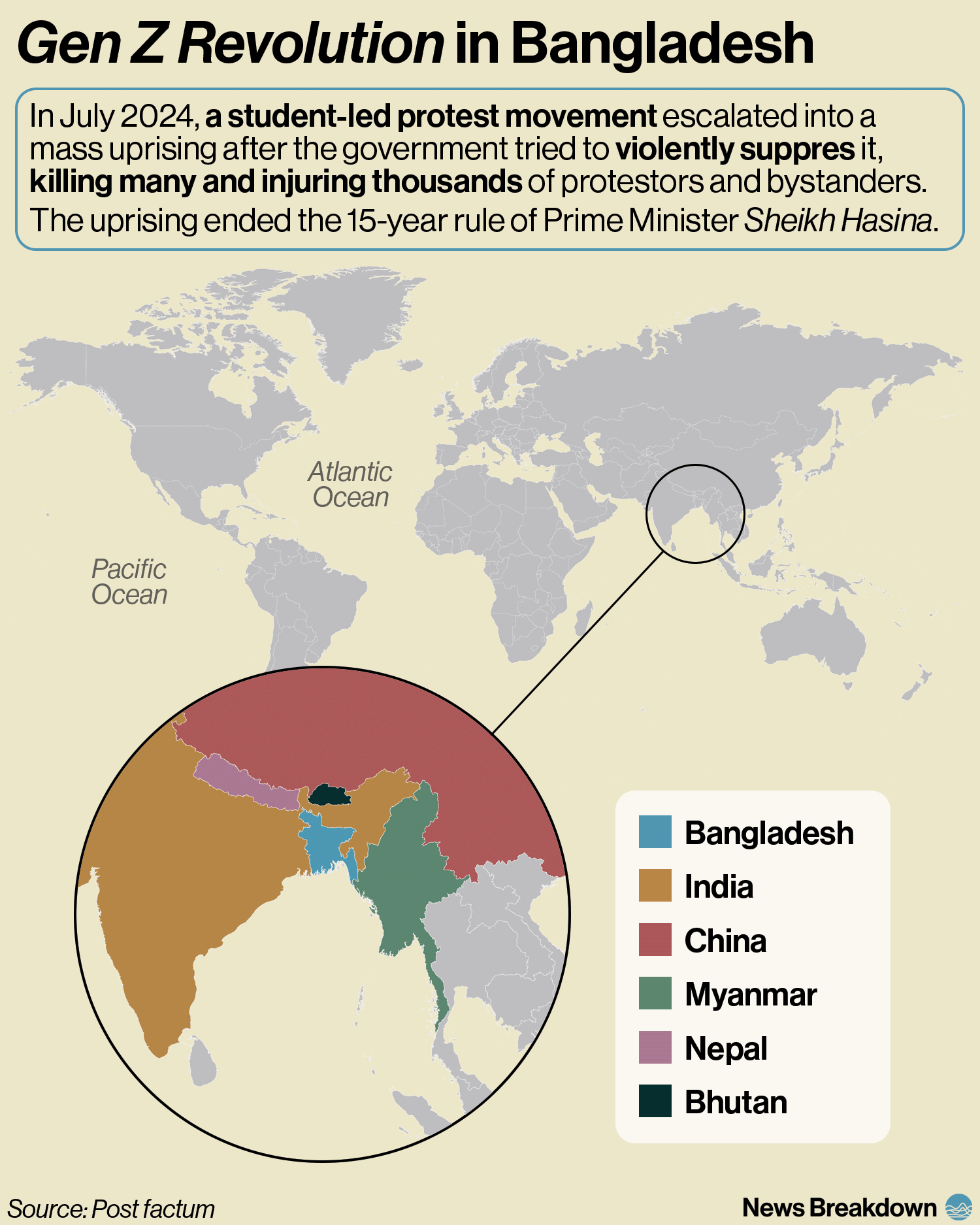
There has been a shift in foreign policy after the collapse of the pro-India Hasina regime.
Relations with India have suffered due to India’s refusal to extradite Hasina (hand her over for a trial).
The interim government wants Hasina to face charges of crimes against humanity and corruption.
This has fuelled anti-India sentiment in Bangladesh, where the "India Out" movement has become popular. Some protesters have targeted Indian products.
The interim government has also accused India of spreading misinformation about the security of theHindu minority in Bangladesh to destabilise the new administration.
These tensions have disrupted trade between the two countries. India has prevented Bangladeshi exporters from using Indian ports, damaging the country’s textile industry.
Business uncertainty has also delayed infrastructure projects that were important to India's regional connectivity strategy.
For India, the collapse of the Hasina regime is a security setback, as it helped to control insurgent groups in India's northeastern states.
Relations with India’s rivals improve
A strategic pivot by the interim government has seen relations improve with India’s rivals, China and Pakistan.
China wants to deepen its influence in the strategically important Bay of Bengal (sea to the east of India).
Bangladesh is partnering with China to modernise its ports, as well as to invest in energy projects and industrial zones.
Bangladesh is also in talks to buy Chinese military equipment.
Relations with Pakistan have been difficult since Bangladesh became independent in the 1971 war.
There have been unprecedented efforts towards reconciliation with a series of high-level diplomatic missions to improve cooperation in trade and even defence.
Both countries are interested in diversifying their alliances and reducing India's regional dominance.
Bangladesh has also improved its relations with the US and the EU.
Western powers had been concerned about human rights and democracy under the Hasina government.
They have welcomed the interim government’s commitment to free and fair elections, and institutional reform.
The US and the EU have shown their support with economic incentives, including discussions on new trade agreements and investment.