Poland: overview
Poland has become a key player in European security.
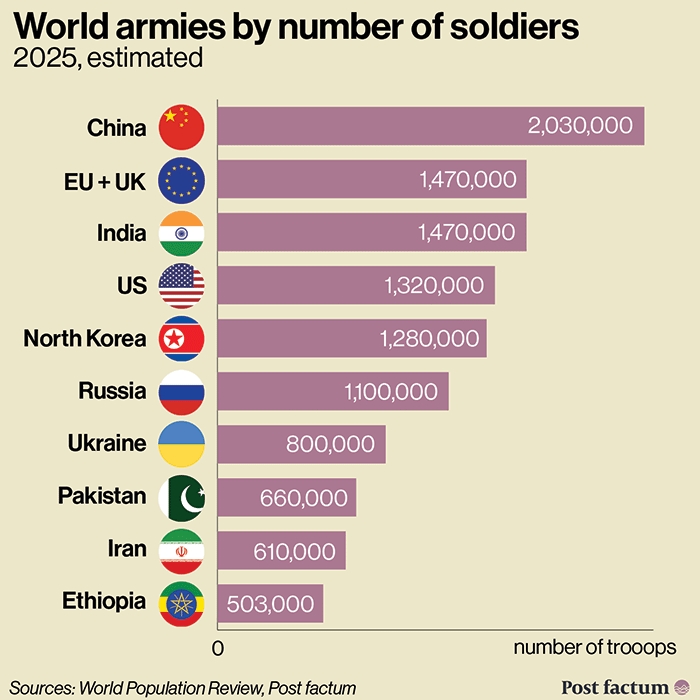
As of 2025, its Armed Forces include 216,000 soldiers, ranking Poland as the largest military force in Europe and the third largest in NATO.
This is a significant rise from 113,000 active personnel in 2021.
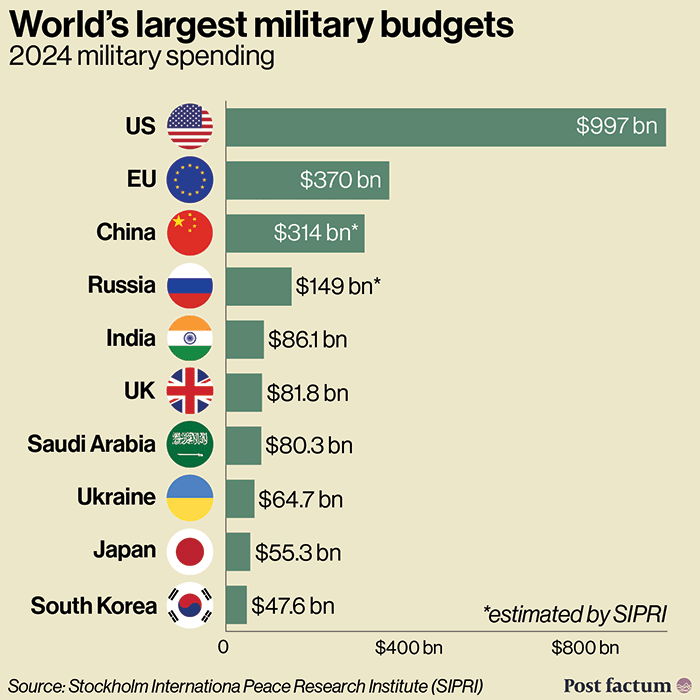
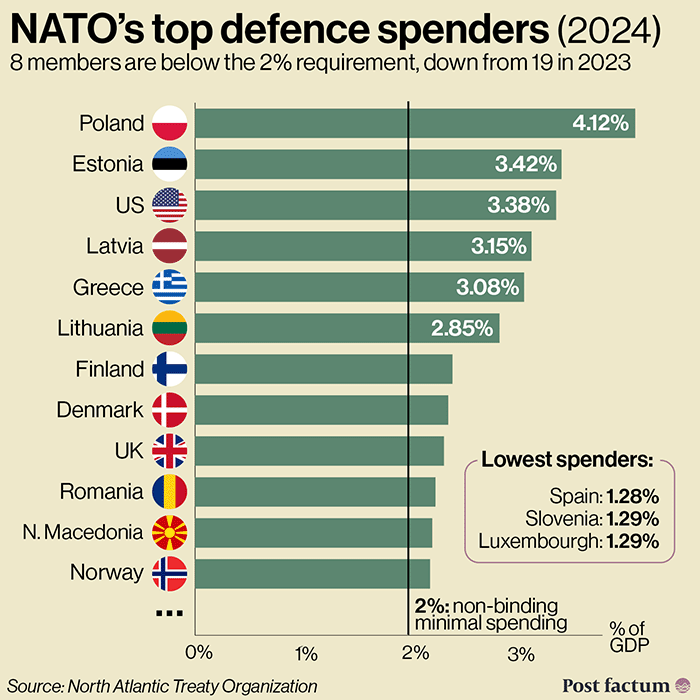
In 2024, Poland’s defence spending reached €37 billion, amounting to 4.12% of its GDP.
The fear of a potential Russian aggression has led to popular support for the military buildup.
Recently, the Polish government announced a plan to introduce voluntary military training for every adult male.
- The goal is to establish a substantial reserve force, with a target of training 100,000 volunteers by 2027.
Poland is building the East Shield, a $2.5 billion, 800-kilometre-long fortification project on the borders with Russia and Belarus.
The country currently hosts around 10,000 US troops.
Germany: overview
Germany’s defence strategy is transforming in response to the changing security context.
As of early 2025, the German army includes over 185,000 active-duty personnel, with plans to expand to 203,000 by 2031.
Germany's defence budget was almost €90 billion in 2024.
In 2025, Germany announced its first permanent foreign military deployment since World War II by setting up a brigade in Lithuania.
The brigade, with approximately 4,800 soldiers, will be ready by 2027.
Approximately 40,000 US troops are stationed in Germany, as well as 15 NATO nuclear bombs.
France: overview
As the only EU member with both a nuclear arsenal and a permanent seat on the UN Security Council, France plays a unique role in European defence.
Troops: 200,000 active soldiers.
France also has the world’s fourth-largest nuclear arsenal, estimated at 290 warheads.
France is the only EU state with nuclear capabilities.
Budget: €59.6 billion in 2024.
In the last decade, France has consistently backed the idea of European defence sovereignty: arguing that Europe must develop the ability to act without US support and approval.
United Kingdom: overview
Although no longer part of the EU, the UK is still involved in European defence cooperation.
Troops: 108,000 active personnel.
Budget: to reach £56.9 billion (€67.8 billion) in 2025.
This increase is part of the commitment to raise defence spending to 2.5% of GDP by 2027, up from the current 2.3%.
The UK keeps Europe’s largest nuclear arsenal, with an estimated stockpile of 225 warheads.
Italy: overview
Troops: 165,000 active personnel.
Budget: €30 billion in 2024, or 1.49% of its GDP, below the NATO target.
In early 2025, the Italian government formally pledged to meet the 2% GDP defence spending threshold by 2028.
Italy is the sixth-largest arms exporter in the world, accounting for 4.8% of global defence exports in 2020-2024.
It hosts around 13,000 US troops and an estimated 35 US nuclear bombs.
Italy is the only country in continental Europe to maintain 2 aircraft carriers, making it a key maritime force within Europe and NATO.
Role of PESCO
In 2017, to address fragmentation, the EU launched PESCO (Permanent Structured Cooperation).
Goal: to promote greater defence integration among willing member states by
- Encouraging collaboration on joint projects
- Developing shared capabilities
- Promoting interoperability of equipment
- Ensuring cost-efficient cooperation
During Joe Biden’s administration, the US issued warnings over increased European military cooperation through PESCO, worrying that it would reduce the relevance of NATO.
Donald Trump’s administration instead pushed for increased European independence from the US in defending security on the continent.